
Shoulder · Odesa
Shoulder pain: when the arm won't lift all the way
It hurts to reach the top shelf, put on a jacket or lie on that side at night?
Most shoulder pain comes from the tendons around the joint (the rotator cuff): they get irritated, overloaded or develop calcium deposits. It's treatable without surgery in most cases. Movement, shockwave therapy, EMTT and manual work are among the options.
- Most common cause
- Rotator cuff tendons
- Often helps
- Shockwave, EMTT, manual work
- Typical course
- 3–6 sessions
- Session
- ≈20 min on a device
- 20+ years of practice
- STORZ MEDICAL devices, Switzerland
- 5.0 on Google Maps
Causes
Why the shoulder hurts
The shoulder is the most mobile joint in the body, and the price of that freedom is that its tendons work hard and are easily overloaded.
Tendinitis / tendinopathy
Irritated rotator cuff tendons after repetitive overhead work, sport or a sudden effort.
Calcific deposits
Calcium deposits in a tendon: sharp pain, especially at night. Shows on an ultrasound or X-ray.
Impingement
The tendon gets pinched when you raise the arm: pain in the middle of the movement.
Frozen shoulder
The capsule stiffens: movement gets more and more limited over months. Needs patience and a doctor's view.
Neck and shoulder blade
Sometimes the pain is referred from the neck, or the shoulder blade moves poorly.
At home
What you can do yourself
Keep the shoulder moving within comfort and avoid what clearly provokes the pain.
- 1
Don't immobilise it
A sling for weeks makes the shoulder stiffer. Move it gently in the painless range.
- 2
Pendulum
Lean forward, let the arm hang and draw small circles for 1–2 minutes, several times a day.
- 3
Fewer overhead tasks
Use a step stool, keep things on lower shelves for a while.
- 4
Sleep support
On your back with a pillow under the elbow, or on the healthy side hugging a pillow.
- 5
Ice or warmth
Whichever feels better: 15 minutes, several times a day.
Red flags
When to see a doctor straight away
See a doctor first if:
- Shoulder or left arm pain with chest pain, shortness of breath or sweating — call emergency services
- You can't lift the arm at all after a fall or a jerk
- The shoulder looks deformed after an injury
- Fever, redness and a hot, swollen joint
- Numbness or weakness in the arm
How we help
How we help
We find which structure hurts, then combine device-based treatment for the tendon with manual work for the shoulder, shoulder blade and neck.
- 1
Assessment
We test movement and strength, check the neck and shoulder blade, look at your ultrasound or X-ray.
- 2
Shockwave therapy
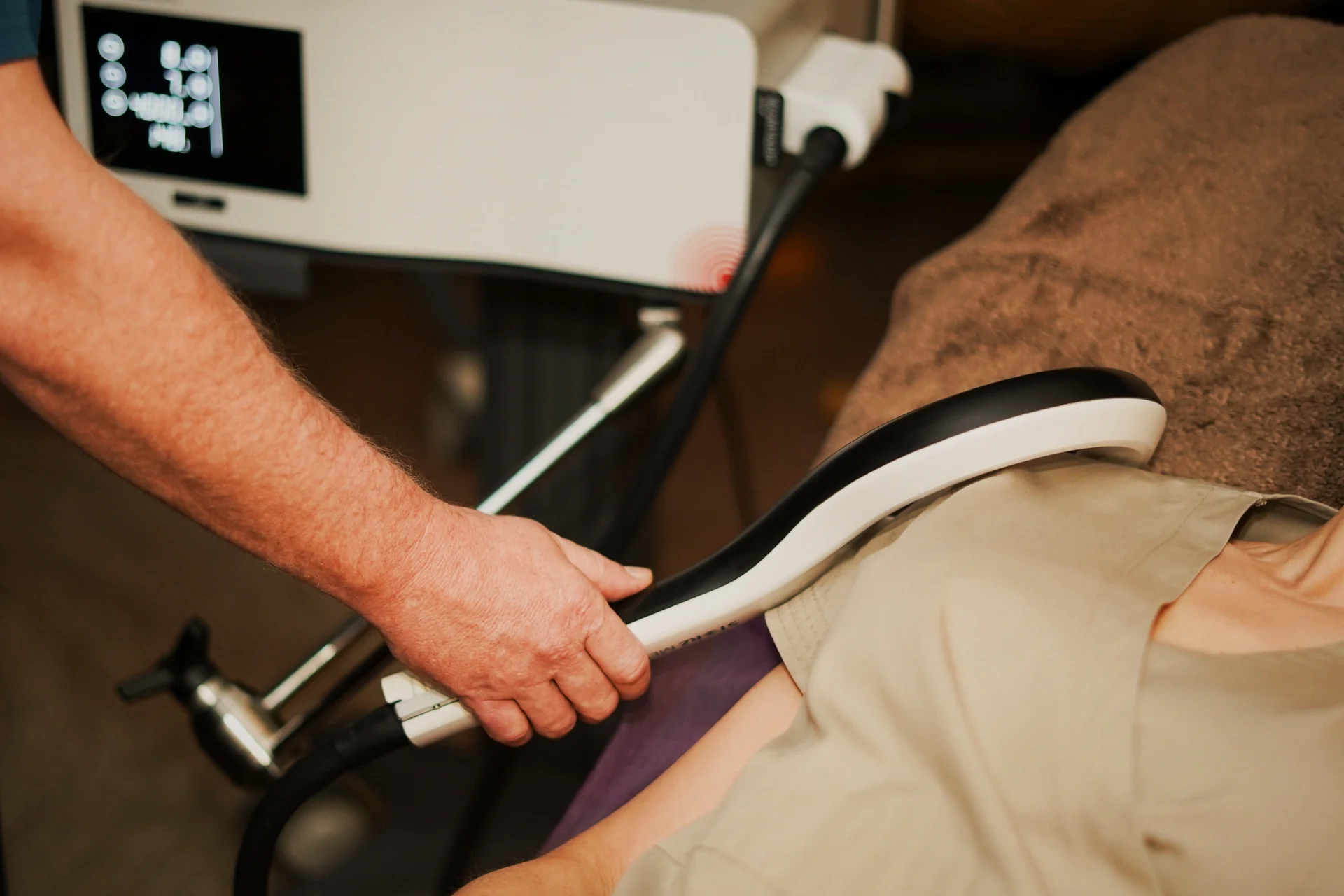
For tendinopathy and calcific deposits: STORZ MEDICAL device, about 20 minutes, once a week.
- 3
EMTT
Painless magnetic stimulation; it can be combined with shockwave therapy.
- 4
Manual work and exercises
Mobilisation of the shoulder blade, upper back and neck, and a short home routine.
What we use and why
- STORZ MEDICAL · SwitzerlandShockwave therapyHeel, shoulder or knee pain that's lasted months? STORZ acoustic pulses, right where the tendon is overloaded. 20 minutes.About the method
- STORZ MEDICAL · SwitzerlandEMTT magnetotransduction therapyChronic pain in the lower back, joints and tendons. Through your clothes, painless, 20 minutes.About the method
- By handOsteopathy and manual therapyBack or neck pain nobody has explained? Careful hands-on work and a plan that makes sense.About the method
Course
How many sessions you may need
Shockwave therapy: usually 3–5 sessions a week apart. EMTT: 6–10 sessions. We'll suggest a plan after the assessment.
Tendons recover slowly, and changes continue for weeks after the course. That's why exercises at home matter.
Frozen shoulder needs more time; we'll explain what to expect honestly.
Prices
First visit · comprehensive therapyStart here
Conversation, assessment and a first session on a personal programme: osteopathic and manual techniques, therapeutic massage
STORZ shockwave therapy
Standard treatment · 0.20 UAH per pulse
EMTT STORZ MEDICAL
Standard treatment · 0.10 UAH per pulse
We'll confirm your programme and course price after the first visit. All prices
Research
What research says
Shockwave therapy is one of the best-studied conservative treatments for calcific shoulder tendinitis.
Systematic review · 2014
28 randomised trials: high-energy shockwave therapy reduced pain, improved function and helped calcium deposits resorb in calcific tendinitis of the shoulder.
Bannuru RR, Flavin NE, Vaysbrot E, et al. High-energy extracorporeal shock-wave therapy for treating chronic calcific tendinitis of the shoulder: a systematic review. Annals of Internal Medicine, 2014.
Randomised trial · 2018
86 patients with shoulder tendinopathy: shockwave therapy combined with EMTT reduced pain more at 24 weeks than shockwave therapy alone.
Klüter T, Krath A, Stukenberg M, et al. Electromagnetic transduction therapy and shockwave therapy in 86 patients with rotator cuff tendinopathy: a prospective randomized controlled trial. Electromagnetic Biology and Medicine, 2018.
We summarise the findings in our own words. Studies describe results in groups of people; your plan is always built around you.
Questions
What people usually ask
Does shockwave therapy hurt?
It's noticeable; many describe it as strong tapping. We adjust the intensity so it stays tolerable.
Do I need an ultrasound first?
It helps a lot: it shows the tendon and any calcium deposits. If you don't have one, we'll tell you after the assessment whether it's needed.
Can I keep training?
Usually yes, with changes. We'll tell you which movements to pause and when to bring them back.
Is it frozen shoulder?
If movement in all directions is limited and getting worse over months, it may be. A doctor confirms it; we help keep and regain movement.
Will I need injections or surgery?
Many people manage without. If conservative care doesn't help, we'll suggest seeing an orthopaedic doctor.
Booking
Let's find a time that suits you
Message or call us and our administrator will reply during opening hours. Not sure what you need? Start with a first visit: we assess first, then choose the method together.
- Address
- 9 Frantsuzkyi Blvd, office 47 (2nd floor), Odesa, Ukraine
- Opening hours
- Mon–Sat 8:00–20:00 (last booking), Sun by appointment
- @osteopathic_ua
Related concerns
People with this often also ask about
- Neck painNeck stiff after a day at the laptop, tension spreading into the shoulders? What helps.Read more
- After injury or sportMovement never fully came back after an injury? Overloaded after training? How we help you recover.Read more
- Tension headacheHead feels squeezed after stress or a long day at the screen? What helps besides pills.Read more