
Lower back · Odesa
Lower back pain: why it happens and what actually helps
It aches after a long day at the desk or a drive, it's hard to straighten up in the morning, and painkillers only last until evening?
In most people lower back pain comes from muscles, joints and ligaments that are overloaded or move too little, not from something dangerous. It usually eases within a few weeks if you keep moving. If it keeps coming back, it's worth finding out why: that's where hands-on work and a clear plan help most.
- Most common cause
- Overload and too little movement
- Often helps
- Osteopathy, massage, EMTT
- Typical course
- 3–6 sessions
- First visit
- 90 min with assessment
- 20+ years of practice
- STORZ MEDICAL devices, Switzerland
- 5.0 on Google Maps
Causes
Why the lower back hurts
In about 9 out of 10 cases doctors call it non-specific back pain: there's no single damaged structure, but muscles, small spinal joints and ligaments are tense, stiff or overloaded.
Long sitting
Eight hours at a desk, then the car and the sofa. Deep muscles switch off, others work non-stop and get tired.
A sudden load
Lifting a heavy bag or a child, an awkward twist, a first gym session after a break.
Stiff neighbours
When the hips, pelvis or mid back move poorly, the lower back takes on extra work.
Stress and poor sleep
They raise muscle tone and make the body more sensitive to pain. It's real, not “in your head”.
Disc changes
A disc bulge or herniation on an MRI is common even in people without pain. It matters only together with your symptoms.
At home
What you can do yourself today
Keep moving gently. Bed rest slows recovery; short walks and an ordinary daily routine speed it up.
- 1
Walk a little, often
10–15 minutes several times a day, at a comfortable pace. Movement is the best thing for the back right now.
- 2
Warmth
A warm shower or a heat pad for 15–20 minutes relaxes muscles and eases stiffness.
- 3
Change position every 30–40 minutes
Get up, stretch, walk to the window. Any position gets tiring if you hold it for long.
- 4
Gentle movement in bed
Lying on your back, slowly rock your bent knees side to side for 1–2 minutes. No pain beyond mild tension.
- 5
Sleep on your side
With a pillow between your knees, or on your back with a pillow under your knees.
Red flags
When to see a doctor straight away
Serious causes are rare, but these signs need a doctor first, today:
- Numbness in the groin or inner thighs, problems with the bladder or bowels — call emergency services
- Weakness in a leg or foot that's getting worse
- Pain after a fall or accident
- Fever, weight loss without a reason, a history of cancer
- Constant pain that doesn't change with position and gets worse at night
How we help
How we help
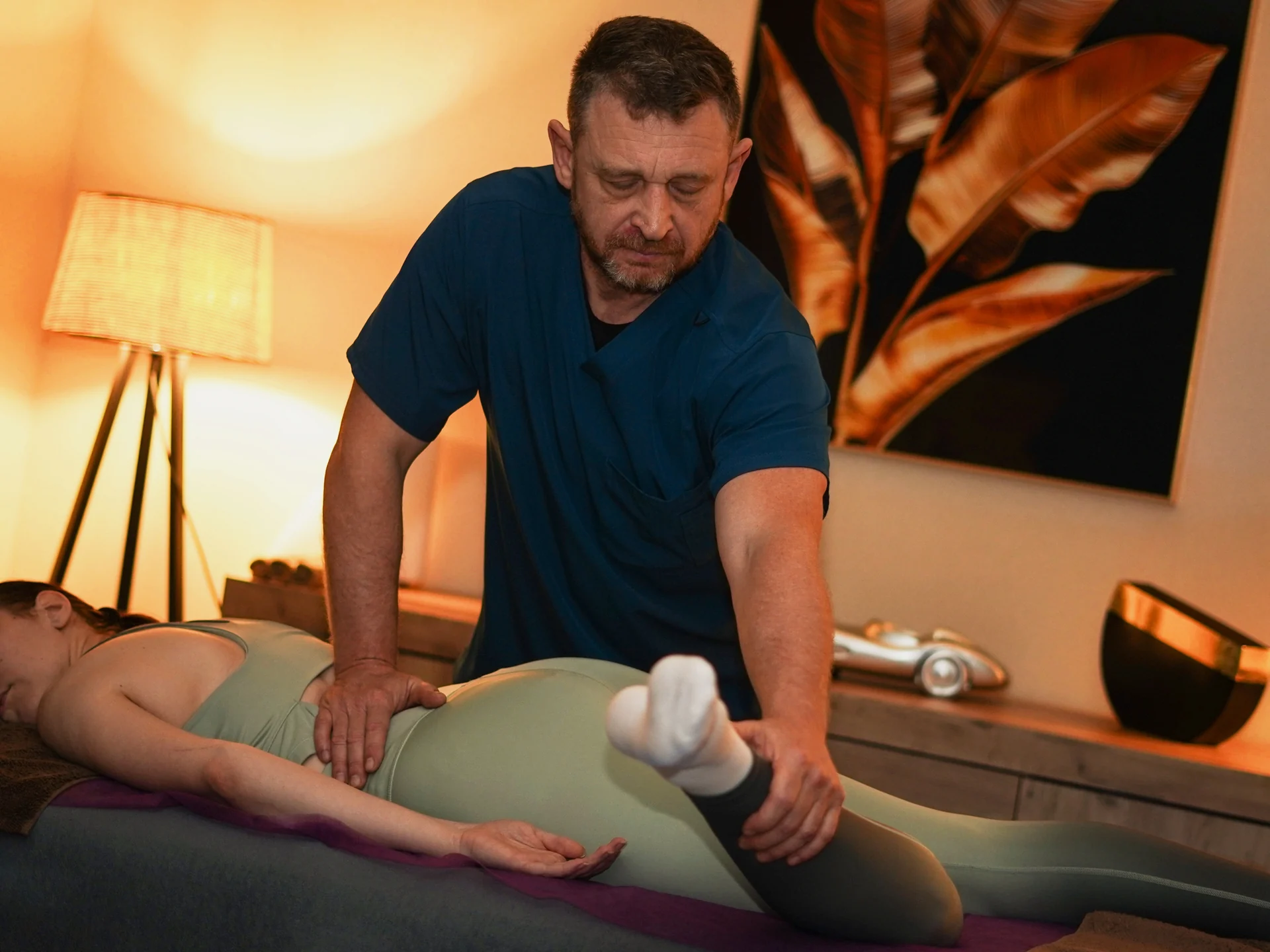
First we find what overloads your back, then we work on it with our hands and, where it helps, with devices. You leave with a plan and a few simple exercises.
- 1
Assessment
We ask how and when it started, look at how you stand, bend and walk, test the spine, pelvis and hips. Bring your MRI if you have one.
- 2
Hands-on work
Osteopathic and manual techniques bring back movement in the stiff segments; massage relaxes overworked muscles.
- 3
EMTT where it fits
For long-lasting back pain we may add EMTT sessions on a STORZ MEDICAL device: painless, about 20 minutes.
- 4
Home plan
2–3 exercises for 5–10 minutes and simple tips for work and sleep, so the result lasts.
What we use and why
- By handOsteopathy and manual therapyBack or neck pain nobody has explained? Careful hands-on work and a plan that makes sense.About the method
- By handTherapeutic massageNeck and shoulders locked up from the laptop, back tired from sitting? An hour of attentive hands-on work.About the method
- STORZ MEDICAL · SwitzerlandEMTT magnetotransduction therapyChronic pain in the lower back, joints and tendons. Through your clothes, painless, 20 minutes.About the method
Course
How many sessions you may need
Often 3–6 sessions 1–2 weeks apart. After 2–3 sessions we look together at what has changed.
Many people feel easier movement after the first sessions. Pain that has lasted for months usually needs more time and regular home exercises.
We'll tell you honestly if your situation needs a doctor or a scan first.
Prices
First visit · comprehensive therapyStart here
Conversation, assessment and a first session on a personal programme: osteopathic and manual techniques, therapeutic massage
Osteopathy / manual therapy
Session on your plan: work with pain and the problem area
Therapeutic massage
Therapeutic or sports recovery: back, neck or full body
EMTT STORZ MEDICAL
Standard treatment · 0.10 UAH per pulse
We'll confirm your programme and course price after the first visit. All prices
Comparison
Which method for which kind of back pain
We choose after the assessment; often we combine methods.
| Osteopathy / manual therapy | Therapeutic massage | EMTT | |
|---|---|---|---|
| What it does | Restores movement in the spine, pelvis and hips | Relaxes tense muscles | Painless magnetic stimulation of tissue |
| When people choose it | Stiffness, pain that keeps returning | Muscle tightness after desk work or sport | Long-lasting pain, as part of a plan |
| Session | 90 min | 90 min | ≈20 min |
Research
What research says
Lower back pain is one of the best-studied areas for hands-on methods, and reviews describe a benefit for pain and mobility.
Meta-analysis · 2014
A meta-analysis of 15 randomised trials: osteopathic treatment reduced pain and improved function in lower back pain.
Franke H, Franke JD, Fryer G Osteopathic manipulative treatment for nonspecific low back pain: a systematic review and meta-analysis. BMC Musculoskeletal Disorders, 2014.
Cochrane review · 2015
A Cochrane review: massage reduced lower back pain and improved function in the short term compared with no treatment.
Furlan AD, Giraldo M, Baskwill A, et al. Massage for low-back pain. Cochrane Database of Systematic Reviews, 2015.
Randomised trial · 2017
A randomised trial: adding EMTT to standard therapy reduced lower back pain and disability more than standard therapy alone.
Krath A, Klüter T, Stukenberg M, et al. Electromagnetic transduction therapy in non-specific low back pain: a prospective randomised controlled trial. Journal of Orthopaedics, 2017.
We summarise the findings in our own words. Studies describe results in groups of people; your plan is always built around you.
Questions
What people usually ask
Should I rest or keep moving?
Keep moving, gently. Short walks and a normal routine help the back recover faster than lying down. Avoid only what clearly makes it worse.
Do I need an MRI first?
Usually not. Scans are needed when there are warning signs, or when pain doesn't ease for weeks. If you already have one, bring it along.
I have a disc herniation. Can you work with that?
Often yes. We decide after the assessment and a look at your MRI. If there's leg weakness or numbness, we'll suggest seeing a doctor first.
Will it hurt?
Mostly not. The techniques are gentle; if something is unpleasant, just say so and we'll change the approach.
Why does my back keep coming back?
Usually because the reason stays the same: long sitting, stiff hips, weak deep muscles. That's why we give you a home plan, not just a session.
Is it worth the money?
You leave the first visit with a clear plan, and after 2–3 sessions we review progress together. If the method doesn't suit you, we'll say so.
Booking
Let's find a time that suits you
Message or call us and our administrator will reply during opening hours. Not sure what you need? Start with a first visit: we assess first, then choose the method together.
- Address
- 9 Frantsuzkyi Blvd, office 47 (2nd floor), Odesa, Ukraine
- Opening hours
- Mon–Sat 8:00–20:00 (last booking), Sun by appointment
- @osteopathic_ua
Related concerns
People with this often also ask about
- SciaticaPulling pain from the back into the buttock or leg? What it means and when to act fast.Read more
- Neck painNeck stiff after a day at the laptop, tension spreading into the shoulders? What helps.Read more
- After injury or sportMovement never fully came back after an injury? Overloaded after training? How we help you recover.Read more