
Heel · Odesa
Heel pain: plantar fasciitis and heel spur
The first steps out of bed are the worst, then it eases, and after a long day on your feet it's back?
Pain under the heel that's worst in the morning is most often plantar fasciitis: overload of the thick band under the sole. A “heel spur” on an X-ray is often found alongside it, but the pain comes from the irritated tissue, not from the spur itself. Shockwave therapy is one of the best-studied ways to help.
- Typical sign
- Pain with the first morning steps
- Often helps
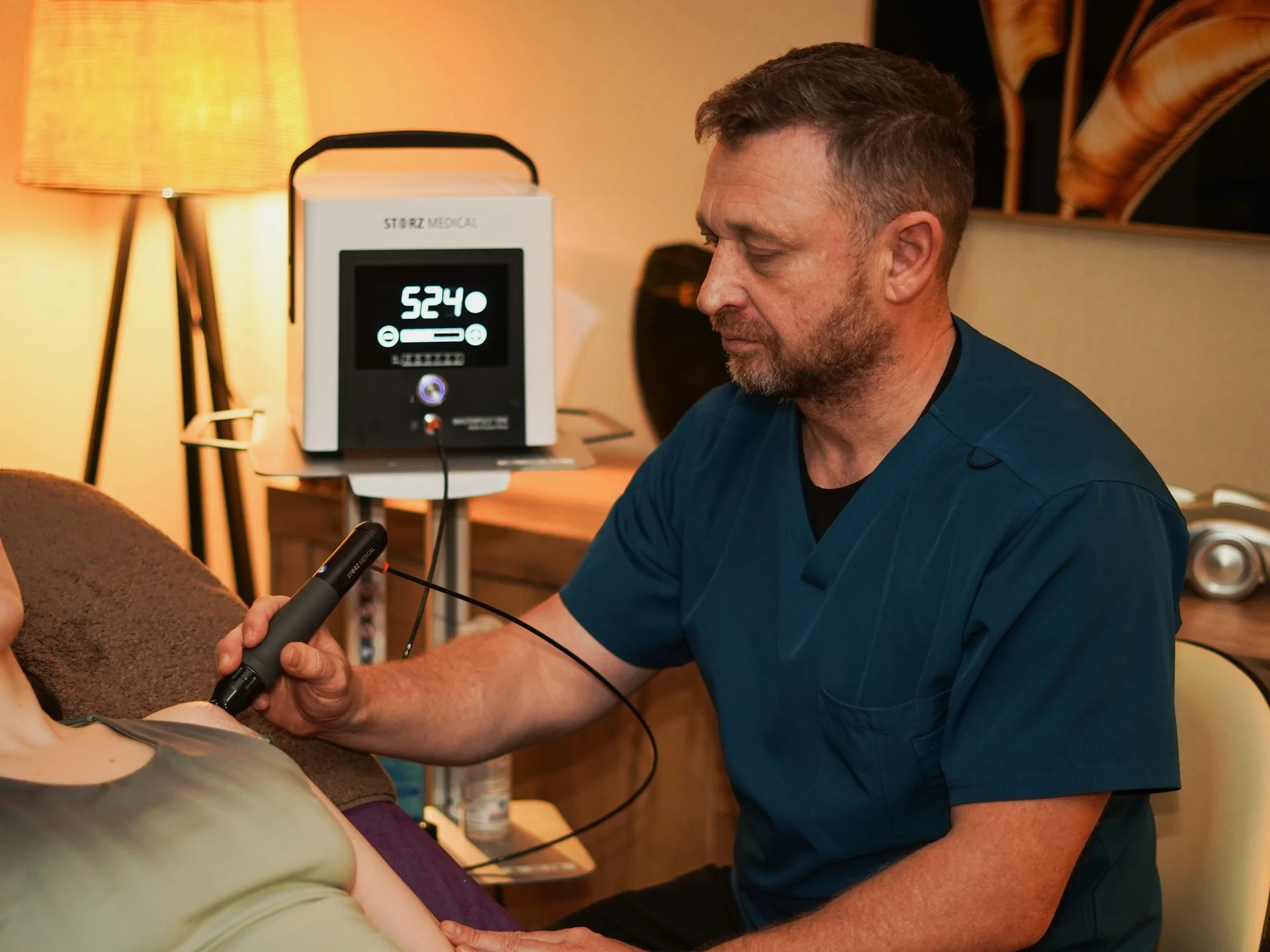
- STORZ shockwave therapy
- Typical course
- 3–5 sessions, weekly
- Session
- ≈20 min
- 20+ years of practice
- STORZ MEDICAL devices, Switzerland
- 5.0 on Google Maps
Causes
Why the heel hurts
The plantar fascia supports the arch of the foot with every step. When the load is more than it can handle, it becomes irritated where it attaches to the heel.
Lots of standing or walking
Especially on hard floors, in flat or worn shoes.
A jump in activity
More running, a long hike, a trip with lots of walking around the city.
Tight calves
A stiff calf and Achilles tendon pull on the fascia.
Weight gain
More load on each step.
Foot shape
Very flat or very high arches change how the load is spread.
At home
What you can do yourself
Reduce the load on the heel for a while and stretch the calf and sole every day.
- 1
Before the first step
In bed, pull your toes towards you with a towel for 30 seconds, 3 times. The first steps hurt less.
- 2
Calf stretch
Against a wall, back leg straight, heel on the floor: 30 seconds, 3 times, twice a day.
- 3
Roll the sole
Roll a ball or a cold water bottle under the foot for 2–3 minutes.
- 4
Supportive shoes
Cushioned sole, a small heel; avoid walking barefoot on hard floors.
- 5
Reduce, don't stop
Swap some running for cycling or swimming for a few weeks.
Red flags
When to see a doctor straight away
See a doctor first if:
- Heel pain after a fall or a jump, you can't put weight on the foot
- The heel is red, hot and swollen, or you have a fever
- Numbness, burning or tingling in the foot
- Pain in both heels with joint pain elsewhere
- Pain at rest and at night, not only when walking
How we help
How we help
We confirm where the pain comes from, treat the fascia with shockwave therapy and work on the calf and foot so the load is spread better.
- 1
Assessment
We check the heel, foot, ankle and calf and look at your X-ray or ultrasound if you have one.
- 2
STORZ shockwave therapy
About 20 minutes, once a week. It's noticeable, and we adjust the intensity to you.
- 3
Calf and foot work
Massage and mobilisation of the calf, ankle and foot.
- 4
Home plan
Stretches, shoe tips, how to return to running or long walks.
What we use and why
- STORZ MEDICAL · SwitzerlandShockwave therapyHeel, shoulder or knee pain that's lasted months? STORZ acoustic pulses, right where the tendon is overloaded. 20 minutes.About the method
- By handTherapeutic massageNeck and shoulders locked up from the laptop, back tired from sitting? An hour of attentive hands-on work.About the method
Course
How many sessions you may need
Usually 3–5 shockwave sessions a week apart. The effect builds up over the following weeks.
Many people notice that the morning steps get easier during the course. Daily stretching helps keep the result.
We'll tell you honestly if your heel needs a doctor or a scan first.
Prices
First visit · comprehensive therapyStart here
Conversation, assessment and a first session on a personal programme: osteopathic and manual techniques, therapeutic massage
STORZ shockwave therapy
Standard treatment · 0.20 UAH per pulse
We'll confirm your programme and course price after the first visit. All prices
Comparison
Plantar fasciitis or heel spur?
They're often mentioned together, but they're not the same thing.
| Plantar fasciitis | Heel spur | |
|---|---|---|
| What it is | Overload of the band under the sole | A small bony outgrowth at the heel, seen on X-ray |
| Does it hurt? | Yes, this is usually the source of pain | Often not; many people have one without pain |
| What helps | Load management, stretching, shockwave therapy | Treated through the fascia: the same approach |
Research
What research says
Shockwave therapy for chronic plantar fasciitis is supported by meta-analyses of randomised trials.
Meta-analysis · 2013
A meta-analysis of randomised trials: shockwave therapy is effective and safe for chronic plantar fasciitis and reduced heel pain.
Aqil A, Siddiqui MR, Solan M, et al. Extracorporeal shock wave therapy is effective in treating chronic plantar fasciitis: a meta-analysis of RCTs. Clinical Orthopaedics and Related Research, 2013.
Systematic review · 2015
A systematic review: shockwave therapy is effective and safe for a range of tendon and fascia problems, including plantar fasciitis.
Schmitz C, Császár NB, Milz S, et al. Efficacy and safety of extracorporeal shock wave therapy for orthopedic conditions: a systematic review on studies listed in the PEDro database. British Medical Bulletin, 2015.
We summarise the findings in our own words. Studies describe results in groups of people; your plan is always built around you.
Questions
What people usually ask
Does shockwave therapy break up the spur?
That's a common myth. It works on the irritated tissue and pain, not by “breaking” bone. The spur itself often doesn't cause pain.
Does it hurt?
It's noticeable, like strong tapping. We start gently and adjust the intensity.
Can I walk normally after a session?
Yes. It's best to avoid long runs and very long walks for 2–3 days.
Do I need insoles?
Sometimes they help. We'll look at your feet and shoes and advise whether it's worth seeing a podiatrist.
How long has it to last before I come?
There's no need to wait. But if it's been more than a few weeks, it's definitely worth getting it checked.
Booking
Let's find a time that suits you
Message or call us and our administrator will reply during opening hours. Not sure what you need? Start with a first visit: we assess first, then choose the method together.
- Address
- 9 Frantsuzkyi Blvd, office 47 (2nd floor), Odesa, Ukraine
- Opening hours
- Mon–Sat 8:00–20:00 (last booking), Sun by appointment
- @osteopathic_ua
Related concerns
People with this often also ask about
- Knee painKnees ache on the stairs, the joint bends less than it used to? What helps besides pills.Read more
- Swollen legsLegs feel heavy and puffy by evening? Why it happens and how lymphatic drainage helps.Read more
- After injury or sportMovement never fully came back after an injury? Overloaded after training? How we help you recover.Read more